

Hey, Cut or Tap readers! The Pokemon World Championships is just a week away, and testing is ramping up as players head into the big event! I’m excited today to write about the deck and list preparation process for Worlds that my testing group and I have just gone over as we work together in the upcoming week. For players not attending Worlds, this process will generally carry over to the process that I use when making a deck and list decision for any tournament (albeit to a smaller scale).
Step 1: Establishing The Decks You’re Looking to Beat (Reading the Metagame)
In determining the play for Worlds, we first need to take a step back and do some analysis on the metagame using whichever tools you have access to. In our case, we have access to the online tournament information, some data from high-ELO PTCGL, historical event data, and word of mouth from players qualified for the World Championships.
We should be looking at the decks that we generally think will be played at a reasonably high level no matter what, and worry yourself less with any individual matchup with less than ~5% play rate.
For example, Gholdengo takes strong matchups into Dragapult, Gardevoir and Grimmsnarl, but has a generally harder time with lesser-played decks (Joltik, Eevees, Typhlosion, Walls, etc.). Meanwhile, Gardevoir has a generally better time with these lesser played decks.
Here’s what we know about the meta from our main sources:
Online Tournament Results
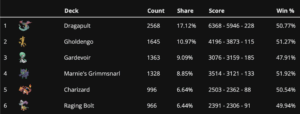
Online tournament results and matchups are generally weak players with little game knowledge, so most things should be taken with a grain of salt, but we can take some major trends from results:
-
- Dragapult Dusknoir has been on a crazy tear lately, winning multiple big tournaments. These results include a solid proportion of credible players piloting the deck (Cali White, Noah Sakadjian, Cal Connor, Saumit Kukkadapu, etc). This gives the deck some pretty good credibility.
- Similar things can be said about Gardevoir, but most of the top results play under aliases of good players that I’m unfamiliar with.
- Other decks generally have less strong players playing these decks online, and lots of lists are playing cards deemed as objectively bad, so those lists become less credible.
After upgrading your membership, you may access the rest of the article:  You must have a Premier Membership or greater to see the rest of this post. If you don't have a Premier account, you can Sign Up for one here.
You must have a Premier Membership or greater to see the rest of this post. If you don't have a Premier account, you can Sign Up for one here.